

Ms. Deborah Huffman is 55 years old. She runs a music school with two admins, and she works about 40 hours a week teaching, scheduling, and prepping for lessons. She just signed with Noto. She's excited, she said "finally" when she saw the product. Now someone has to move years of her students, payments, and schedules out of five different pieces of software and into a system she hasn't learned yet, without her ever closing her doors.
At Noto, our main bottleneck isn't sales. Because of the state of legacy incumbents in our market, our value proposition is clear and obvious to almost anyone we talk to. The harder problem is what happens after a customer signs: getting Ms. Huffman and her two admins to actually move their payments, scheduling, and invoice data over, all while the business keeps running.
Noto's customers are the country's small tutoring businesses, music schools, driving schools, and other lesson based businesses. Together they make up an estimated 3% of all household spend. These are mom and pop operations, and they're often not tech savvy. Most run their business on a wide range of ill-fitting software that creates a heavy operational burden. That's why Noto's offering is attractive: a clean single system that consolidates all their tools and handles their back office.
Two questions
First: how do you get a busy operator to migrate? Deborah doesn't have slack in her week to learn a new system and re-enter years of data on top of everything else she's running. So we do it for them.
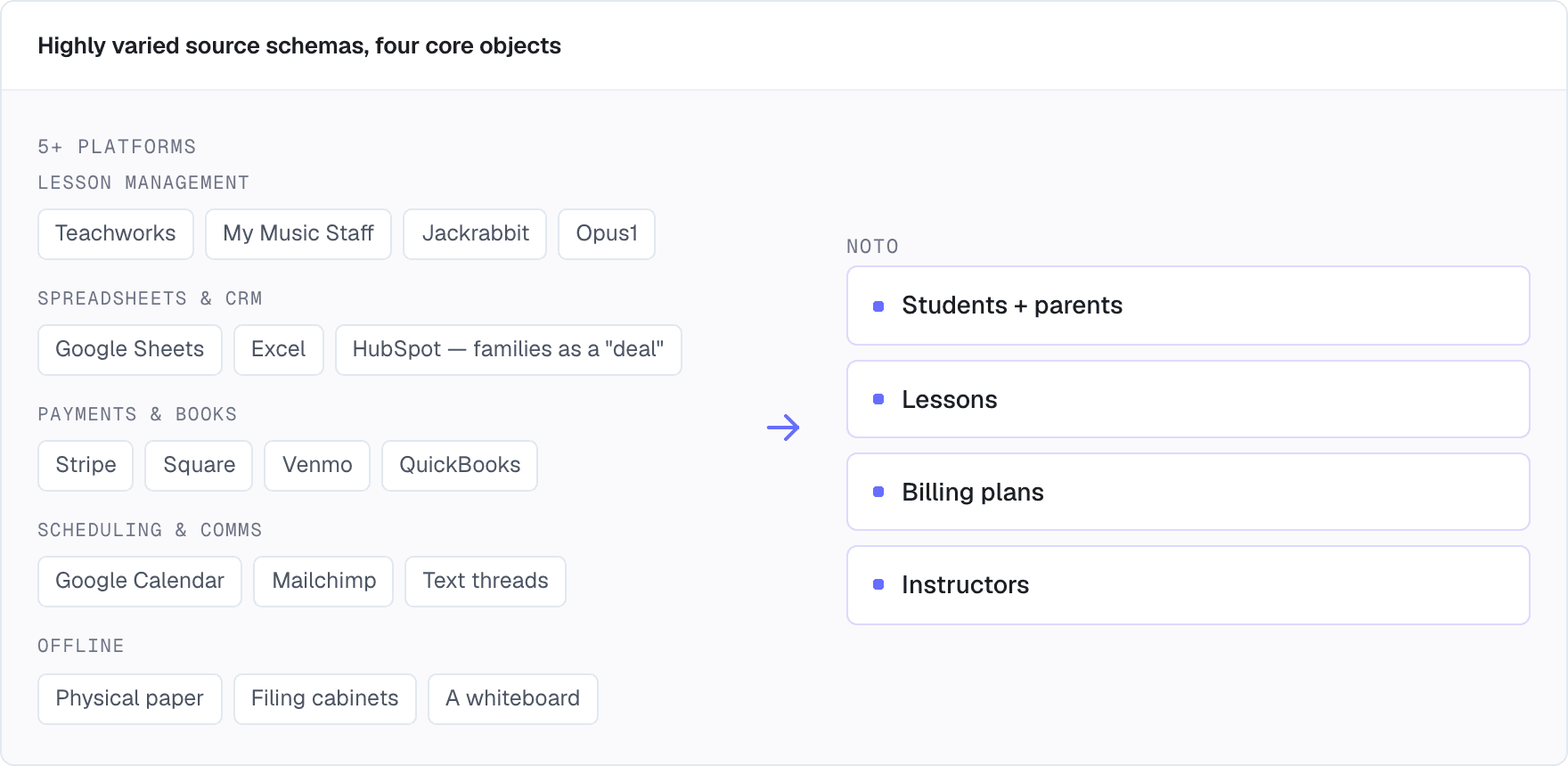
Second: how do you do that at scale, across every customer? Our customers are often on 5+ platforms, and the original schema of the data is highly varied and sometimes hard to parse. Imagine a customer originally on HubSpot who models their families into the "deal" abstraction vs a customer who just keeps everything in a giant spreadsheet.
Pre-AI, this operation is intensely laborious. It requires a human who understands both the source platform and Noto's schema, doing manual mapping customer by customer. It hurts unit economics, it drags out onboarding times, and it decreases onboarding success.
Post-AI, it's practically solved.
How we do it
Establish your core objects. For us, that's students + parents, lessons, billing plans, and instructors. With these four fundamental constructs, you can model out the core pieces of almost any customer's business.
Build a flexible pipeline for raw, unstructured data. Think a browser plug-in that captures screenshots of a legacy platform. Think internal tooling that organizes the raw data once it's in.
Ground the transformation in AI prompts. Basic prompts that describe our schema, point to specific places in the codebase, and cover common patterns in source data.
Let AI execute the transformation through an MCP, built directly on our core database operations, that reads the raw data and writes it into Noto's schema.
Put a simple interface in front of the team. Slack, internal tooling, whatever your non-technical people already live in. Nobody running onboarding should have to touch code. Everyone runs the same prompts through the same tools, so anyone on the team can turn a migration around quickly and get a consistent result every time.
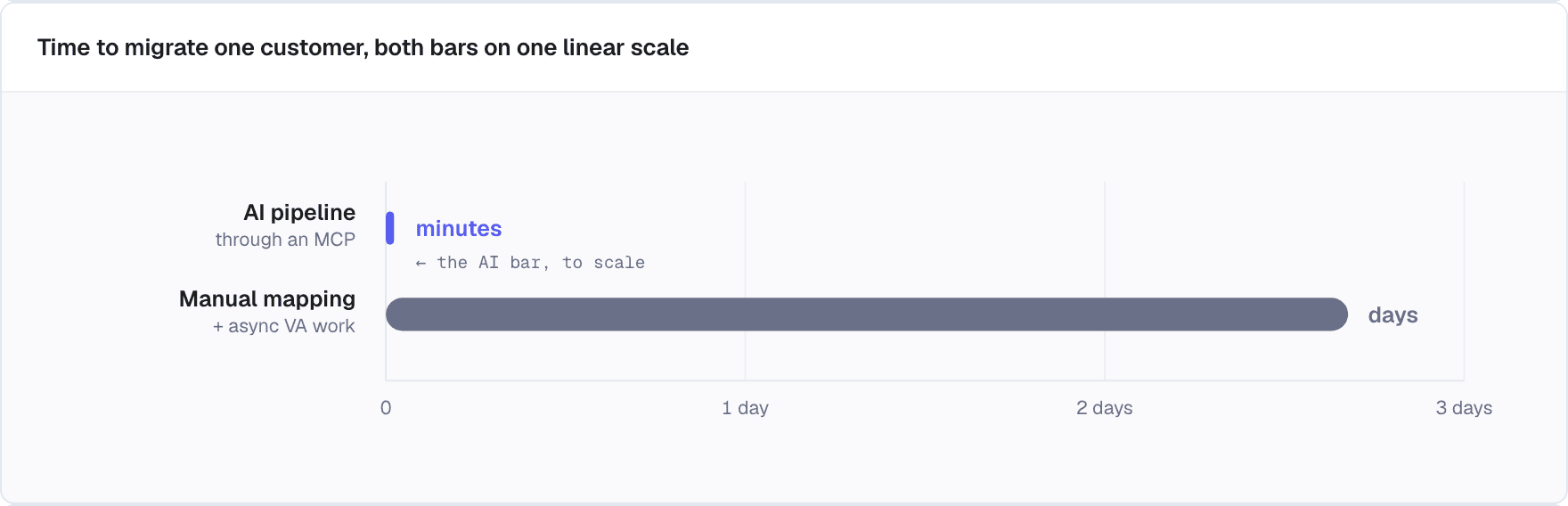
The result: migrations that used to take days, even with async VA work, now happen in minutes.
The magic moment
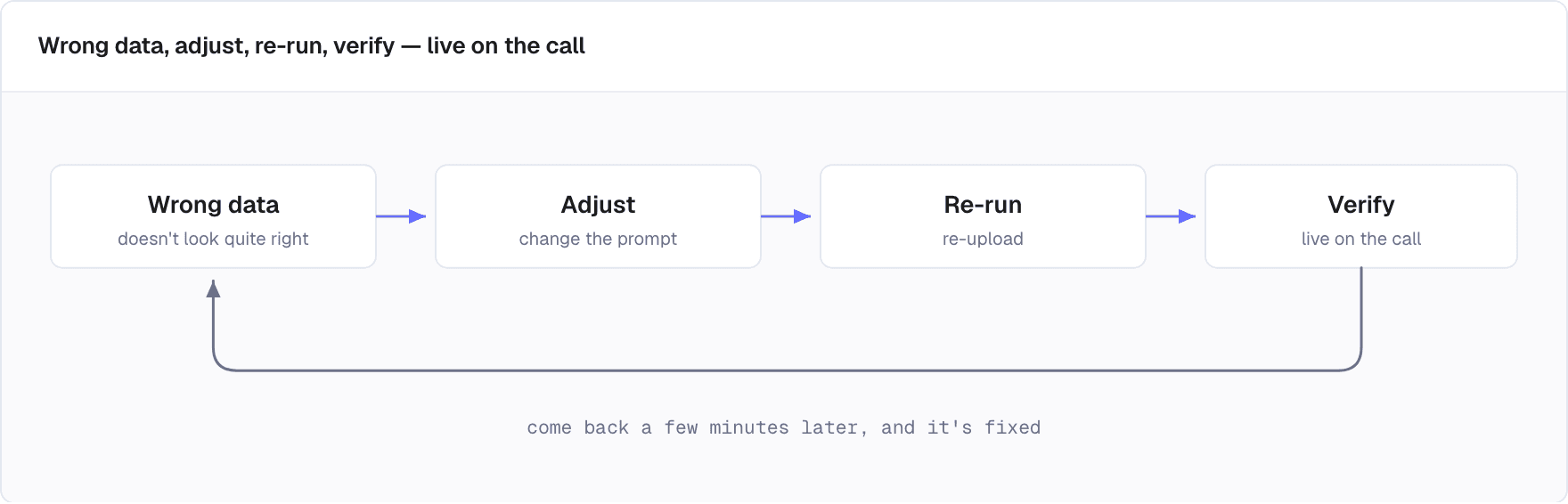
This also unlocks something good for customers. Say you're on an onboarding call and the data doesn't look quite right. No problem: change the prompt, re-upload. Walk through another part of the product, come back a few minutes later, and it's fixed.
That loop, wrong data, adjust, re-run, verify, live on the call, just wasn't possible when migration meant days of manual work or manual scripts. It's only possible now because the ingestion is fast and flexible enough to iterate on in real time.
Why this matters
This isn't as flashy as an AI that picks up the phone and books your appointment. But you could argue it's just as big an unlock. Our bottleneck was never convincing Deborah Huffman that Noto is better than what she has. It's getting her and her two admins to actually move payments, scheduling, and invoice data over while the business keeps running. And this isn't an exploratory AI project we're burning tokens on to see what sticks. It's customer success tooling with a hard payoff: time to onboarding measured in minutes instead of days, and an onboarding team whose capacity is no longer capped by how many source schemas a human can learn. Solving that scalably is what lets us grow.