

You've probably spent hours researching tutoring rates online, only to find conflicting advice that doesn't match your specific situation. Setting the right price feels like guesswork when you're balancing what families can afford with what your expertise is actually worth. Fortunately, there are proven strategies that successful tutors use to price confidently while building sustainable businesses. With the right approach to rate setting and tutoring tools, you can stop undercharging and start earning what you deserve.
TLDR:
Tutoring rates range from $30 per hour for high school students to $120 per hour for specialists
Certified teachers earn 45% more than college students, typically $50-100 per hour
Test prep commands premium rates at $50-120 per hour due to high-stakes outcomes
Group tutoring can increase hourly earnings while staying affordable for families
Noto helps tutoring businesses automate billing and save up to $5,000 monthly on processing fees
Your Educational Experience (And Training) Matters

Your tutoring experience directly impacts what you can charge and rates vary widely based on credentials and teaching background. Here are some general guidelines on what you can charge based on your educational experience:
Subject or Level | Typical Hourly Rate |
|---|---|
High School Student | $30-100 per hour |
College Student | $60-110 per hour |
Test Prep | $50-120 per hour |
New tutors should start conservatively to build testimonials and referrals. According to TutorCruncher's research, rates increase naturally as you show results. What's more, certified teachers can often charge much more due to their professional training and classroom experience.
Remember that initial competitive pricing is an investment in your tutoring business growth. Once you build credibility, regular rate increases become much easier to implement.
Geographic Location Factors
Your location has a big impact on what you can charge for tutoring services. Urban markets with higher living costs support premium rates, while rural areas typically see lower pricing. Tutoring businesses in expensive cities can charge premium pricing due to increased overhead and market demand. Consider the following math tutoring rates in several different sized cities:
City | Hourly Rate | Notes |
|---|---|---|
New York | $25 per hour | High demand market and high cost of living |
Los Angeles | $23 per hour | High demand market |
Chicago | $22 per hour | Strong tutoring market |
Colorado Springs | $15.25 per hour | Below national average |
Regional differences also affect what subjects are in demand. Tech hubs see higher rates for STEM tutoring, while college towns may have more competition but steady demand. Just remember to consider your local competition when setting rates. Research what other tutoring businesses charge in your area using platforms like Care.com for market insights.

Subject-Specific Pricing
Different subjects command varying rates based on complexity, demand, and the specialized knowledge required. Understanding these differences helps you price competitively and maximize revenue.
STEM subjects typically earn premium rates. Math tutoring can range from $30 to $60 per hour, while advanced calculus or physics can upwards of up to $75 per hour due to specialized expertise requirements. In fact, advanced subjects like AP courses, organic chemistry, and upper-level mathematics can command 50-75% higher rates than basic elementary subjects.
Test preparation commands the highest rates at $50 to $120 per hour, according to MyEngineeringBuddy. SAT, ACT, and college entrance exam tutoring supports premium pricing because of time-sensitive results and high stakes.
Language arts and reading generally fall in the $10 to $50 per hour for online and $15 to $80 per hour for in-person lessons, according to Tutors.com. Writing instruction for college essays can push rates higher.
Foreign languages vary widely. As per TutorCruncher, common languages like Spanish average $27.50 per hour, while specialized languages can reach $60+ per hour.
Elementary subjects typically start at $20-30 per hour but require less specialized knowledge.
Grade Level Considerations
The grade level of your students has an impact on what you can charge. If you are tutoring elementary school children in general subjects, you will probably charge much less than if you are tutoring college level students or providing test preparation. In general, the following provides a rough baseline for tutoring rates by grade level.
Subject or Level | Typical Hourly Rate |
|---|---|
Elementary (K-5) | $25 to $45 per hour |
Middle School (6-8) | $35 to $60 per hour |
High School | $50 to $80 per hour |
College-level or test prep | $70 to $120+ per hour |
Niche or technical subjects (i.e., coding, physics) | $60 to $100+ per hour |
When managing different grade levels, consider implementing flexible payment options to accommodate varying family budgets across age groups.
Online vs In-Person Rate Differences

While you may be offering the same level of instruction and expertise, pricing definitely differs between online and in-person tutoring. Understanding these differences can help optimize your pricing strategy.
Online tutoring typically runs $10 less per hour than in-person sessions. Virtual sessions eliminate travel time, which saves you cost, but require reliable internet, quality webcams, and digital whiteboard tools. In addition, online tutoring eliminates geographic limitations, allowing you to serve students nationwide while reducing overhead costs by approximately 15-20%.
In-person tutoring at learning centers commands standard market rates since families travel to you. This model offers consistent scheduling without transportation costs associated with driving to different locations.
In-home tutoring typically costs 60% more than online tutoring due to travel time and transportation expenses.
Group vs Private Session Pricing
Group tutoring changes your pricing structure and revenue potential. While individual rates decrease, total earnings per hour often increase a lot. In group sessions, your typical price will probably be around 75% of private rates per student. A $40 private session becomes $30 per student in groups, but serving three students generates $90 per hour.
As you consider group tutoring, remember that there is an optimal size. According to Institute of Education Sciences, a good group size ranges from 2-4 students to maintain high quality instruction.
Business Overhead and Cost Considerations
Running a tutoring business involves some overhead costs that must be factored into your pricing strategy. Understanding these expenses can help create sustainable rates that cover costs and generate profit. Tutoring Mavericks provides some baseline startup and monthly costs. As a guiding principle, that successful tutoring businesses typically allocate 15-25% of revenue toward overhead costs, making sure they can grow while keeping prices competitive.
Startup costs typically range from $1,000-5,000. This includes business registration, insurance, marketing materials, and initial technology investments.
Monthly business expenses average $500-2,000 for most tutoring businesses. Key costs include tutoring software ($30-50 monthly), liability insurance, marketing, and administrative tools.
Transportation costs add $0.50-2.00 per mile for in-home tutoring. Factor travel time and vehicle expenses when setting rates for mobile services.
Technology investments include video conferencing tools, digital whiteboards, and management software. TutorCruncher's analysis shows these costs averaging $100-300 monthly.
Professional development and continuing education maintain your competitive edge but require budget allocation.
Your rates must cover these overhead expenses plus generate reasonable profit margins for business sustainability. Consider business management solutions that consolidate multiple needs, reducing overall software costs while simplifying administrative tasks.
Payment Structure Options
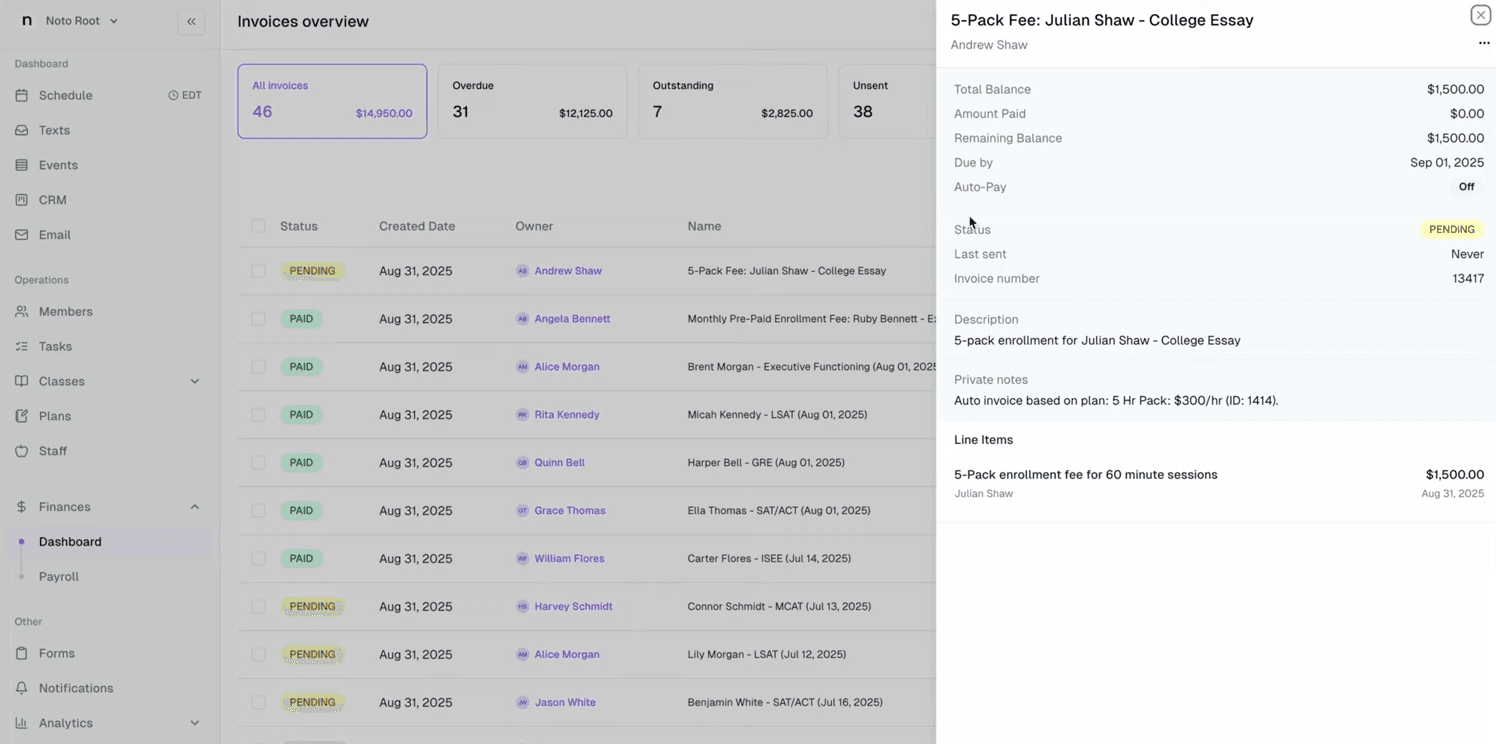
Your payment structure directly impacts cash flow and student retention. Different models serve different business needs and family preferences. Consider the following as basic guidelines for setting your pricing strategy.
Pay-per-session offers maximum flexibility but creates unpredictable revenue. For example, students pay $30-80 per lesson, making budgeting challenging for both parties.
Package deals provide upfront cash flow while offering student discounts. For example, a 10-session package at $45 per lesson versus $50 individual rates encourages commitment.
Monthly subscriptions create predictable revenue streams. For example, a family might pay $200-800 monthly for weekly sessions, making budgeting easier while providing consistent income to you.
Semester packages work well for academic year planning. Students prepay for 15-20 weeks at discounted rates, providing substantial upfront capital.
Subscription models generate the most stable revenue but you should also consider offering multiple payment options to accommodate different family financial situations.
Consider implementing automated billing systems that handle different payment structures while reducing administrative overhead and improving collection rates.
Rate Increase Strategies
Implementing rate increases requires strategic timing and clear communication to maintain client relationships while growing your tutoring business revenue. Keep in mind that your clients may balk at sudden pricing changes so give at least 30 days notice for rate increases, explaining the value improvements that support higher pricing, such as enhanced curriculum or proven student success rates.
Annual increases of 7-10% help your rates keep pace with inflation and reflect your growing experience. Plan these adjustments during natural transition periods like new school years or semesters.
Experience-based increases should occur after major milestones. Raise rates after completing certifications, achieving measurable student improvements, or reaching client capacity.
Market-driven adjustments become necessary when local competition raises their rates or demand exceeds your availability.
Grandfathering existing clients at current rates for 2-3 months while charging new clients higher rates eases the transition in order to maintain existing relationships while implementing necessary increases.
Value demonstration makes increases more acceptable. Share student progress reports, testimonials, or additional services you've added.
For reference, successful tutors typically increase their rates every 12-18 months rather than waiting years.
FAQ
How often should I raise my tutoring rates?
Most successful tutors increase rates every 12-18 months by 7-10% to keep pace with inflation and reflect growing experience. Plan increases during natural transition periods like new school years and provide at least 30 days notice to existing clients.
What's the difference between charging for online versus in-person tutoring?
Online tutoring typically runs $10 less per hour than in-person sessions due to eliminated travel costs, while in-home tutoring commands 60% more than online tutoring because of transportation time and convenience. That said, virtual sessions reduce overhead but may require technology investments.
Can group tutoring actually increase my hourly earnings?
Yes, group tutoring can increase hourly earnings by 50-150% while staying affordable for families. For example, charging $30 per student (versus $40 for private sessions) with three students generates $90 per hour instead of $40.
When should I consider switching from pay-per-session to monthly billing?
Monthly payment plans increase student retention by 35-40% compared to pay-per-session models and create predictable revenue streams. Consider switching when you have consistent demand and want to improve cash flow while making budgeting easier for families.
Final thoughts on setting your tutoring rates
Setting the right tutoring rates doesn't have to feel like guesswork when you understand your market value and local demand. Your expertise deserves fair compensation, whether you're just starting out or you're a seasoned educator with years of experience. As your tutoring business grows, a complete solution can simplify your billing and payment processes, letting you focus on what you do best. The market conditions are strong, so price with confidence and watch your tutoring business thrive.